
Introduction
Early-stage capital project planning often begins with a difficult question:
“How much will this project cost?”
At the concept or feasibility stage, the project team typically has:
- Limited design information
- Undefined scope details
- No detailed engineering drawings
- Significant uncertainty around site conditions and technical requirements
Yet organizations must still make major investment decisions at this stage.
This is where Parametric Estimating becomes essential.
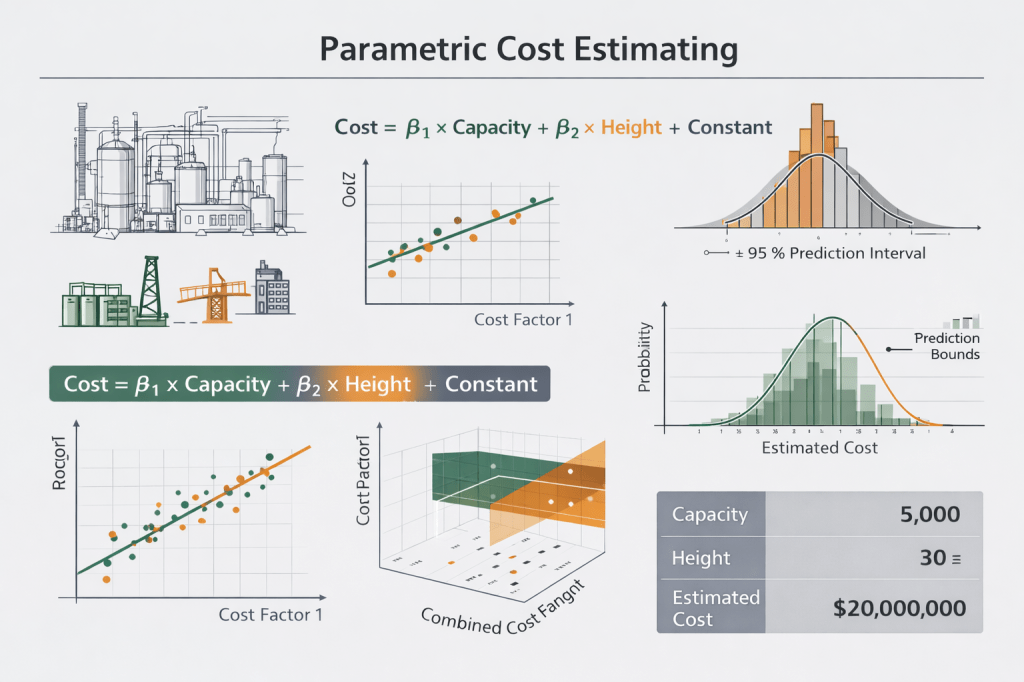
Parametric estimating allows project teams to produce fast, defensible conceptual cost estimates using statistical relationships derived from historical project data.
It is widely used for:
- infrastructure development
- mining projects
- energy projects
- real estate feasibility studies
In industry estimating standards such as AACE International, parametric methods are commonly used in Class 5–4 conceptual estimates, where design definition may be only 0–15% complete.
What Is Parametric Estimating?
Parametric estimating is a cost estimating technique that uses statistical relationships between project variables and cost to generate estimates.
Instead of calculating every material and labor component individually, parametric models rely on cost drivers that strongly influence project costs.
Common Parametric Relationships
Typical relationships include:
| Project Type | Parametric Variable | Example Metric |
|---|---|---|
| Buildings | Floor area | Cost per m² |
| Highways | Road length | Cost per km |
| Power plants | Generation capacity | Cost per MW |
| Mining facilities | Production capacity | Cost per ton per year |
| Pipelines | Diameter × length | Cost per km |
For example:
Office Building Estimate
Project Cost = Building Area × Cost per m²
If the model shows $2,800/m², a 20,000 m² building would estimate:
20,000 × $2,800 = $56,000,000
The strength of parametric estimating lies in leveraging historical project data to establish these relationships.
When Parametric Estimating Is Used
Parametric estimating is typically applied during the earliest phases of capital project development, including:
| Project Stage | Typical Use |
|---|---|
| Concept screening | Evaluate multiple project options |
| Pre-feasibility | Compare technical alternatives |
| Feasibility studies | Develop investment decision estimates |
| Early development | Establish initial project budgets |
These stages often correspond to:
- Class 5 Estimates — 0–2% design definition
- Class 4 Estimates — 1–15% design definition
At these stages:
- Detailed material quantities do not exist
- Engineering design is incomplete
- Construction methods are uncertain
Therefore, detailed bottom-up estimating is impossible.
Parametric models provide rapid order-of-magnitude cost insight for decision-makers.
Common Parametric Estimating Methods
Parametric estimating can take several forms depending on the available data and project complexity.
1. Unit Rate Models
The simplest parametric models use unit cost rates.
Examples include:
- Cost per m² of building area
- Cost per km of highway
- Cost per MW of installed power capacity
Example:
Highway Cost = Road Length × Cost per km
If a road costs $6M/km, then:
50 km highway = $300M estimate
This approach is widely used in:
- real estate development
- infrastructure planning
- early transportation studies
2. Capacity Factor Models
Capacity factor models are common in industrial and mining projects.
These models account for economies of scale.
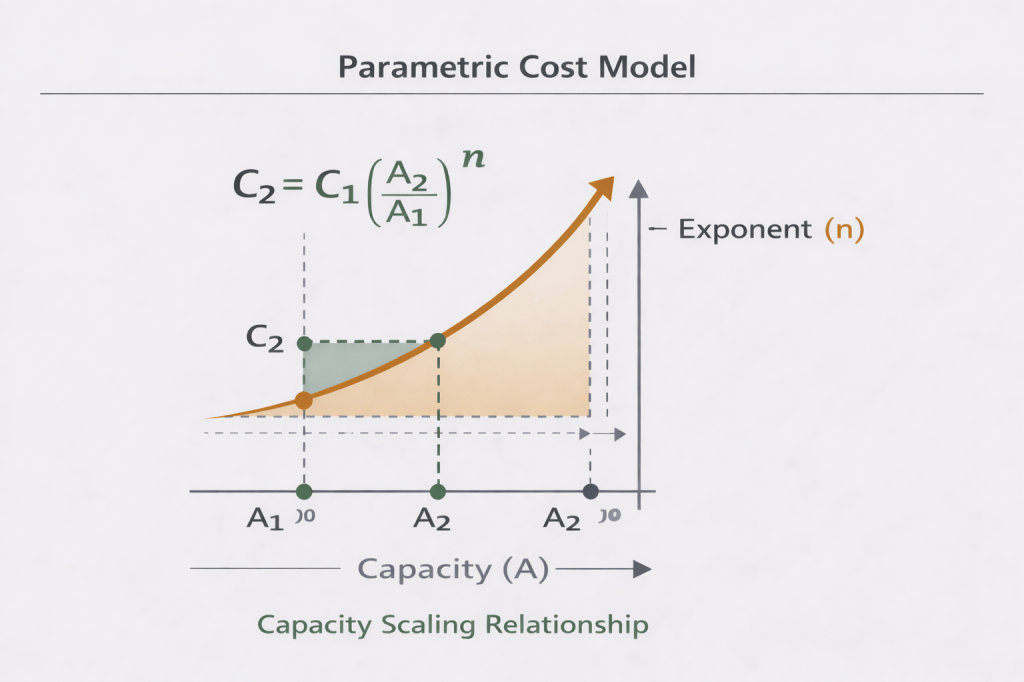
A widely used formula is:
Cost₂ = Cost₁ × (Capacity₂ / Capacity₁)^Exponent
Where the exponent is typically 0.6–0.8.
Example:
If a 100,000 t/year processing plant costs $200M, a 200,000 t/year plant might cost:
Cost₂ = 200M × (200,000 / 100,000)^0.65
Cost₂ ≈ $314M
This reflects the fact that doubling capacity rarely doubles cost.
3. Statistical Regression Models
More advanced parametric models use statistical regression analysis.
These models may include multiple cost drivers such as:
- capacity
- location
- site conditions
- complexity factors
- labor productivity
Example regression model:
Cost = a + b₁(Capacity) + b₂(Site Complexity) + b₃(Location Factor)
These models are commonly used by:
- large engineering firms
- government infrastructure agencies
- mining project developers
because they require large historical project databases.
Framework: How to Build a Parametric Cost Model
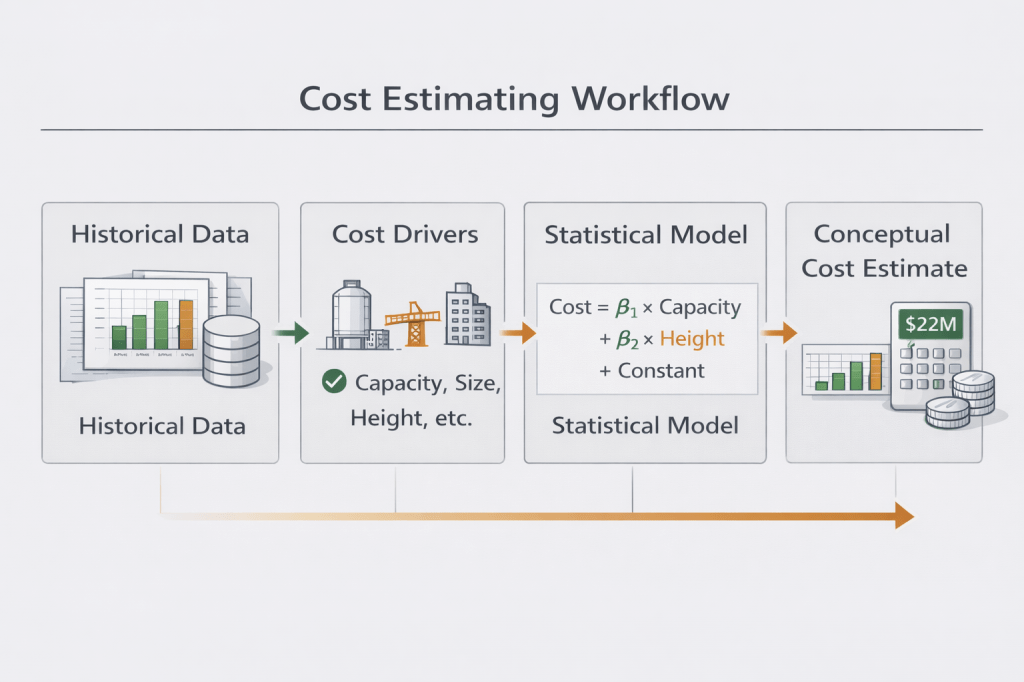
Building a reliable parametric cost model requires a structured process.
Parametric Model Development Framework
| Step | Description |
|---|---|
| 1 | Define the cost variable |
| 2 | Identify key cost drivers |
| 3 | Collect historical project data |
| 4 | Normalize costs |
| 5 | Develop parametric relationships |
| 6 | Validate the model |
Step 1 — Define the Cost Variable
Determine the cost metric you want to predict.
Examples:
- total project cost
- installed equipment cost
- EPC cost
Step 2 — Identify Key Cost Drivers
Drivers should be:
- measurable
- strongly correlated with cost
- available early in the project
Typical drivers include:
- floor area
- capacity
- length
- throughput
Step 3 — Collect Historical Project Data
Reliable parametric models require large datasets of completed projects.
Typical data sources:
- internal project archives
- contractor bid records
- public infrastructure cost databases
Step 4 — Normalize Costs
Raw project costs must be adjusted for comparability.
Normalization may include:
| Adjustment | Example |
|---|---|
| Inflation | Escalate historical costs to current year |
| Location | Adjust for regional labor rates |
| Scope | Remove non-comparable elements |
| Currency | Convert to common currency |
Without normalization, parametric models become misleading.
Step 5 — Develop Parametric Relationships
Methods may include:
- simple ratios
- scaling relationships
- regression models
Statistical tools such as Excel, Python, or specialized cost software are commonly used.
Step 6 — Validate the Model
Validation ensures the model performs reliably.
Validation methods include:
- comparing predictions to known project costs
- analyzing residual error
- testing the model on unseen project data
Worked Example: Parametric Estimate for a Solar Power Project
Consider a conceptual utility-scale solar farm.
Known inputs:
| Parameter | Value |
|---|---|
| Installed capacity | 150 MW |
| Average cost | $1.1M per MW |
Basic Parametric Estimate
Project Cost = Capacity × Cost per MW
150 × $1.1M = $165M
Adjustments
The estimate may then be adjusted for:
| Adjustment | Factor |
|---|---|
| Remote location | +8% |
| Challenging soil conditions | +5% |
| Inflation escalation | +4% |
Adjusted cost:
$165M × 1.17 ≈ $193M
This type of estimate can often be produced within hours, compared to weeks for a detailed estimate.
Advantages of Parametric Estimating
Parametric estimating offers several important benefits.
Speed
Conceptual estimates can be produced very quickly.
Early Decision Support
Project teams can rapidly evaluate:
- multiple project concepts
- site alternatives
- technology options
Scenario Analysis
Parametric models enable rapid scenario testing, such as:
- capacity changes
- site conditions
- cost escalation scenarios
Limitations and Risks
Despite its usefulness, parametric estimating has important limitations.
Poor Historical Data
If project data is incomplete or inaccurate, the model becomes unreliable.
Inappropriate Cost Drivers
Selecting weak or irrelevant drivers leads to poor predictions.
Scope Differences
Historical projects may not be truly comparable.
Lack of Normalization
Failure to adjust for inflation or location can distort results.
For these reasons, parametric models must be maintained and updated regularly.
Best Practices for Parametric Cost Estimating
Experienced estimators typically follow several best practices.
Recommended Practices
| Practice | Why It Matters |
|---|---|
| Use large datasets | Improves statistical reliability |
| Normalize all costs | Ensures comparability |
| Update models regularly | Reflects market changes |
| Validate models | Prevents systematic bias |
| Combine with expert judgment | Adds practical insight |
Parametric estimating should support — not replace — professional estimating judgment.
Key Takeaways
- Parametric estimating enables fast conceptual cost estimates using statistical cost relationships.
- It is most effective in early-stage capital project planning when design information is limited.
- Common approaches include unit rate models, capacity factor models, and regression models.
- Successful parametric models rely on high-quality historical project data and proper normalization.
- The best results come from combining parametric models with experienced estimator judgment.
 Cost Intelligence Lab
Leave a comment