
Introduction
No project estimate is perfectly certain.
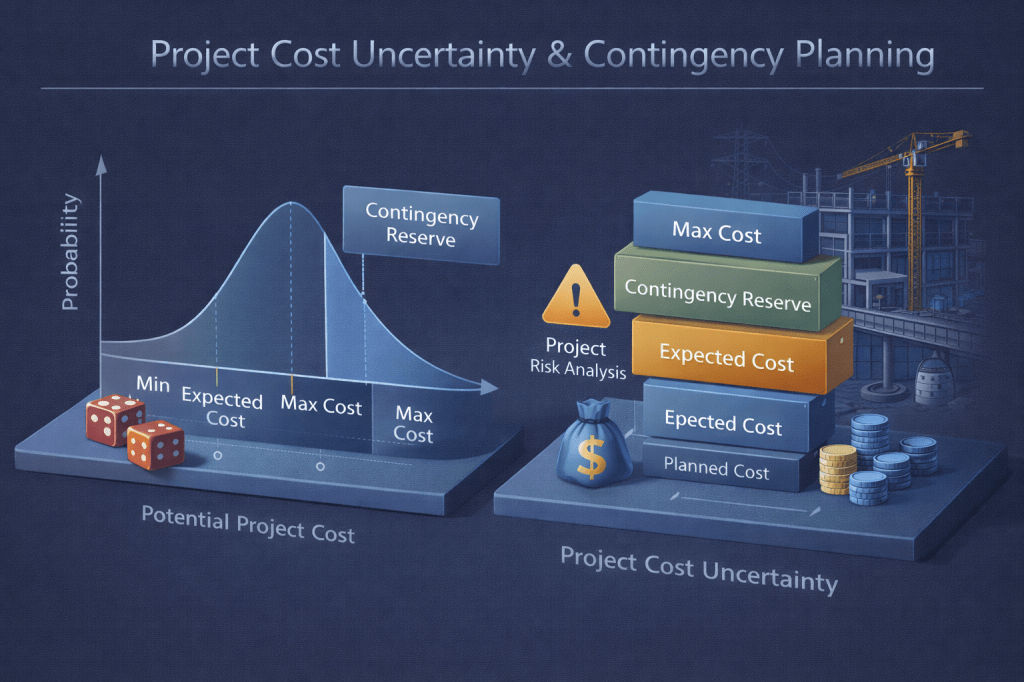
Even the most experienced cost engineers must deal with uncertainty in capital project planning. Early project estimates often contain significant unknowns due to:
- incomplete engineering design
- uncertain site conditions
- fluctuating material prices
- labor productivity variability
- evolving project scope
Without accounting for these uncertainties, project budgets become fragile and unrealistic.
To manage this uncertainty, project estimates include a Cost Contingency.
Contingency is one of the most misunderstood components of project cost estimates. Many stakeholders assume it is a buffer for mistakes or poor estimating.
In reality, contingency is a structured allowance designed to account for expected uncertainty in project execution.
What Is Cost Contingency?
Cost contingency is a budget allowance added to a project estimate to cover uncertainties and risks that are expected but not yet fully defined.
A key principle in professional estimating is:
Contingency is not an error allowance.
Instead, contingency reflects the uncertainty inherent in project scope and execution.
Conceptual Formula
Total Project Estimate = Base Estimate + Contingency
Where:
| Component | Description |
|---|---|
| Base Estimate | Estimated cost of defined project scope |
| Contingency | Allowance for uncertainty and expected risks |
For example:
| Cost Component | Amount |
|---|---|
| Base project estimate | $180M |
| Contingency | $36M |
| Total estimate | $216M |
The contingency amount reflects the level of uncertainty remaining in the estimate.
Why Contingency Is Necessary
Capital projects are exposed to many uncertainties.
These uncertainties arise across several areas.
Design Development
As engineering progresses, design details often change.
Examples include:
- structural revisions
- equipment specification changes
- layout modifications
Material Price Fluctuations
Commodity prices—such as steel, copper, or concrete—can change significantly during project development.
Labor Productivity Variations
Actual labor productivity may vary depending on:
- site conditions
- workforce skill levels
- contractor performance
Site Conditions
Subsurface conditions are a common source of project cost uncertainty.
Examples include:
- unexpected soil conditions
- groundwater issues
- rock excavation requirements
Weather and Environmental Conditions
Weather delays or environmental restrictions may increase project costs.
Without contingency, these uncertainties would quickly lead to budget overruns.
Difference Between Contingency and Management Reserve
One of the most common sources of confusion is the difference between contingency and management reserve.
| Feature | Contingency | Management Reserve |
|---|---|---|
| Included in cost estimate | Yes | No |
| Covers | Identified uncertainties | Major unforeseen changes |
| Controlled by | Project team | Senior management |
| Purpose | Manage expected risk | Protect overall project budget |
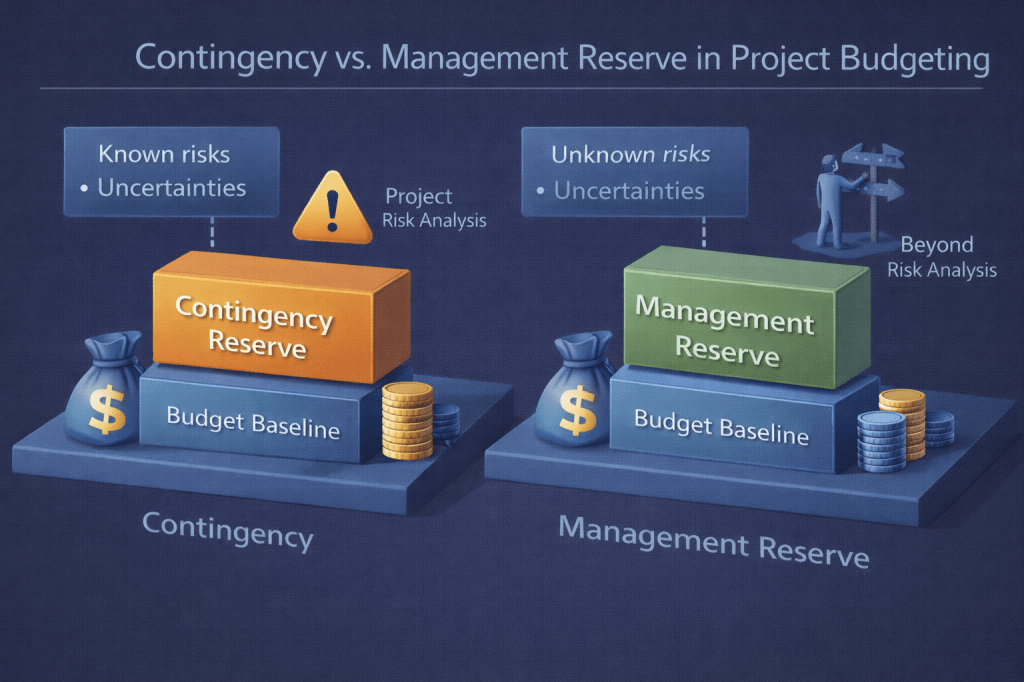
In project management standards from the Project Management Institute, contingency is part of the cost baseline, while management reserve sits above the baseline.
Types of Contingency in Project Cost Estimates
Different types of contingency may be applied depending on project stage and uncertainty.
Design Contingency
Design contingency accounts for uncertainty due to incomplete engineering design.
It is most common in early-stage estimates when many project elements are not yet fully defined.
Examples include:
- undefined equipment specifications
- incomplete layouts
- preliminary structural design
Design contingency typically decreases as engineering progresses.
Construction Contingency
Construction contingency covers uncertainty during project execution.
Examples include:
- productivity variation
- minor scope adjustments
- contractor inefficiencies
- small design changes during construction
This type of contingency remains even in late-stage estimates.
Risk-Based Contingency
For large capital projects, contingency may be calculated using formal risk analysis methods.
These methods analyze project risks and estimate their potential cost impacts.
Common techniques include:
- structured risk registers
- probabilistic cost modeling
- scenario analysis
Risk-based contingency is often used in large infrastructure and mining projects.
How Contingency Changes Across Estimate Classes
Contingency levels should decrease as the project becomes better defined.
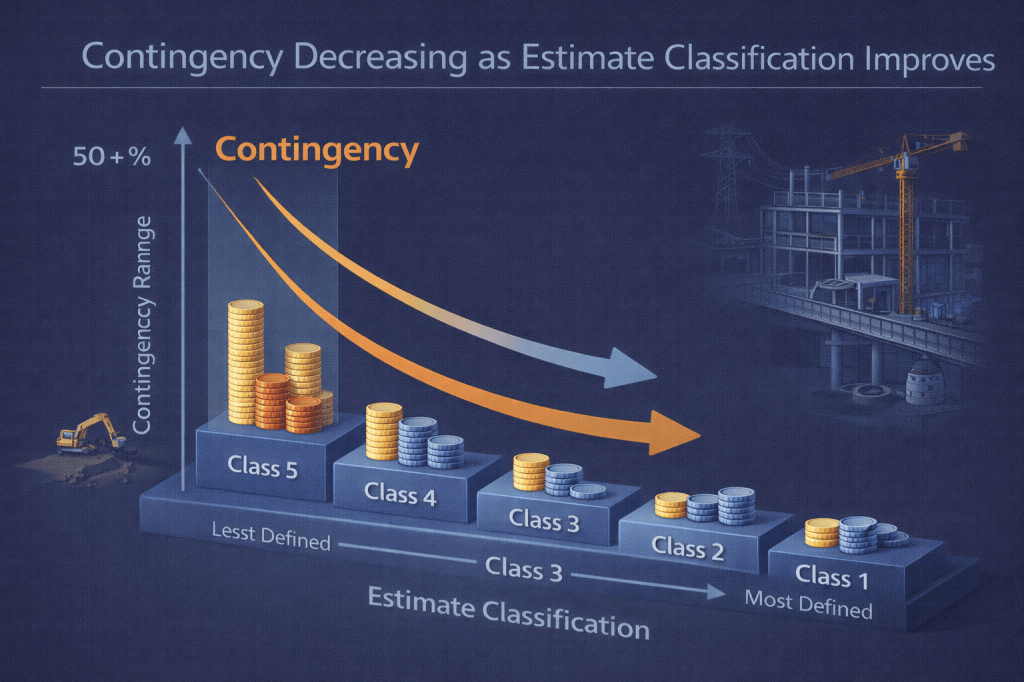
Estimate classification standards published by AACE International illustrate this relationship.
Typical Trend
| Estimate Class | Design Definition | Typical Contingency |
|---|---|---|
| Class 5 | 0–2% | 30–50% |
| Class 4 | 1–15% | 20–40% |
| Class 3 | 10–40% | 10–25% |
| Class 2 | 30–70% | 5–15% |
| Class 1 | 65–100% | 3–10% |
The reason is simple:
As project information improves, uncertainty decreases.
Therefore, contingency allowances should gradually reduce as design maturity increases.
Methods for Calculating Contingency
Several methods are used to estimate contingency.
Percentage-Based Contingency
The simplest approach is applying a percentage to the base estimate.
Example:
| Estimate Stage | Contingency |
|---|---|
| Concept estimate | 30% |
| Feasibility estimate | 20% |
| Detailed estimate | 10% |
Example calculation:
Base Estimate = $120M
Contingency = 20%
Contingency Amount = $24M
Total Estimate = $144M
This method is common in smaller projects or early-stage estimates.
Risk Register Approach
A more structured approach involves identifying potential project risks.
Each risk is evaluated using:
- probability of occurrence
- estimated cost impact
Example:
| Risk | Probability | Impact | Expected Cost |
|---|---|---|---|
| Soil instability | 30% | $10M | $3M |
| Steel price increase | 20% | $8M | $1.6M |
| Weather delays | 15% | $6M | $0.9M |
Total contingency would be approximately:
$5.5M
This method produces a risk-informed contingency estimate.
Monte Carlo Simulation
Large capital projects often use probabilistic modelling techniques such as Monte Carlo Simulation.
Monte Carlo simulation works by:
- modeling uncertainties in cost drivers
- generating thousands of possible cost outcomes
- calculating probability distributions of total cost
Project teams can then choose contingency levels based on confidence levels such as:
| Confidence Level | Interpretation |
|---|---|
| P50 | 50% chance of not exceeding cost |
| P80 | 80% chance of not exceeding cost |
| P90 | Conservative contingency level |
This approach is widely used in major infrastructure and energy projects.
Common Mistakes in Contingency Planning
Several mistakes frequently occur in contingency planning.
Using Arbitrary Percentages
Applying contingency percentages without risk analysis can produce misleading estimates.
Confusing Contingency With Management Reserve
These two allowances serve different purposes and should remain separate.
Not Updating Contingency
Contingency must be adjusted as project definition improves.
Removing Contingency to Reduce Budgets
Sometimes contingency is reduced to make budgets appear smaller.
This practice often results in significant cost overruns later.
Best Practices for Contingency Management
Experienced cost engineers follow several best practices.
| Best Practice | Benefit |
|---|---|
| Base contingency on risk analysis | Improves reliability |
| Update contingency as design evolves | Reflects reduced uncertainty |
| Document contingency assumptions | Improves transparency |
| Separate contingency from management reserve | Maintains budget integrity |
Effective contingency planning improves project financial resilience.
Key Takeaways
- Cost contingency is an allowance added to project estimates to account for uncertainty.
- It reflects expected risks, not estimating errors.
- Contingency should decrease as project design becomes more defined.
- Structured approaches such as risk analysis and Monte Carlo simulation produce more reliable contingency estimates.
- Separating contingency from management reserve improves project budget management.
 Cost Intelligence Lab
Leave a comment