
Introduction
When evaluating a capital project, it’s tempting to focus on initial construction cost.
However, this approach often leads to poor investment decisions.
Many projects with low upfront cost end up being expensive to operate, maintain, and sustain over time.
To make informed decisions, project teams must understand the balance between:
- capital cost (CapEx)
- operating cost (OpEx)
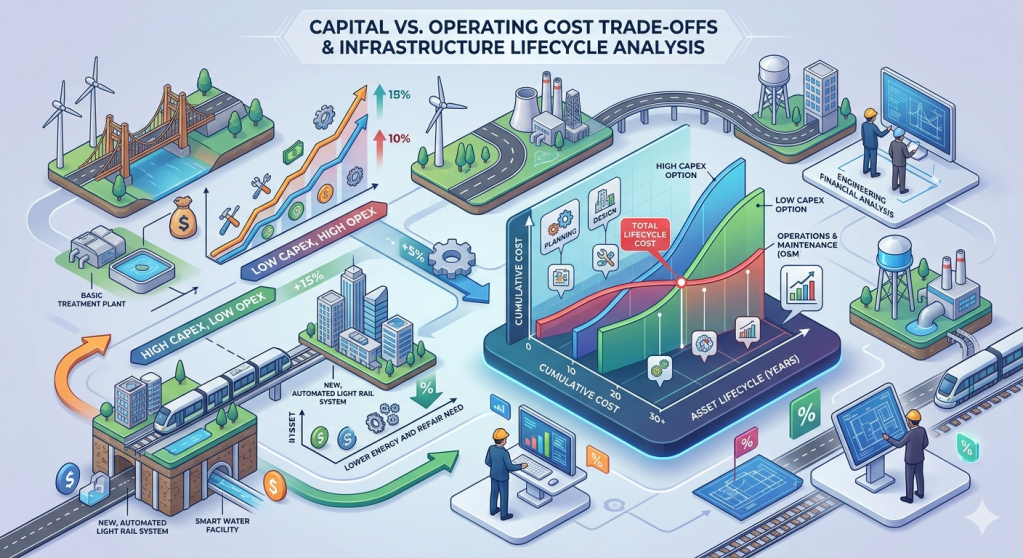
The most successful capital projects are not necessarily the cheapest to build—they are the most economical over their entire lifecycle.
What Is Capital Cost (CapEx)?
Capital cost (CapEx) refers to the initial investment required to build, acquire, or install a project asset.
It is typically incurred before the project becomes operational.
Typical CapEx Components
| Category | Examples |
|---|---|
| Land acquisition | site purchase, legal fees |
| Engineering & design | feasibility studies, detailed engineering |
| Construction | civil, structural, mechanical, electrical works |
| Equipment | machinery, systems, installation |
| Commissioning | testing and startup |
CapEx is usually treated as a capitalized investment on the balance sheet and depreciated over time.
What Is Operating Cost (OpEx)?
Operating cost (OpEx) refers to the ongoing expenses required to operate and maintain the asset throughout its life.
Unlike CapEx, OpEx continues for the entire operational period.
Typical OpEx Components
| Category | Examples |
|---|---|
| Labor | operators, maintenance crews |
| Energy | electricity, fuel |
| Maintenance | routine servicing, spare parts |
| Consumables | chemicals, materials |
| Repairs | equipment replacement and fixes |
OpEx is treated as a recurring expense and directly impacts annual project cash flow.
Key Differences Between CapEx and OpEx
| Aspect | CapEx | OpEx |
|---|---|---|
| Timing | Upfront (construction phase) | Ongoing (operations phase) |
| Nature | Investment | Expense |
| Accounting | Capitalized | Expensed |
| Frequency | One-time or phased | Recurring |
| Impact | Initial funding requirement | Long-term profitability |
Understanding this distinction is essential for project financial planning and evaluation.
Why CapEx vs OpEx Matters in Project Decisions
Project decisions often involve trade-offs between CapEx and OpEx.
Common Trade-Off Scenarios
| Scenario | Outcome |
|---|---|
| Higher CapEx | Lower long-term OpEx |
| Lower CapEx | Higher ongoing OpEx |
Example
- Installing energy-efficient equipment increases upfront cost
- But reduces energy consumption over time
This trade-off directly affects:
- project profitability
- operating margins
- long-term financial performance
In capital-intensive industries like mining, infrastructure, and energy, these decisions can impact billions of dollars over a project’s life.
Lifecycle Costing: The Bigger Picture
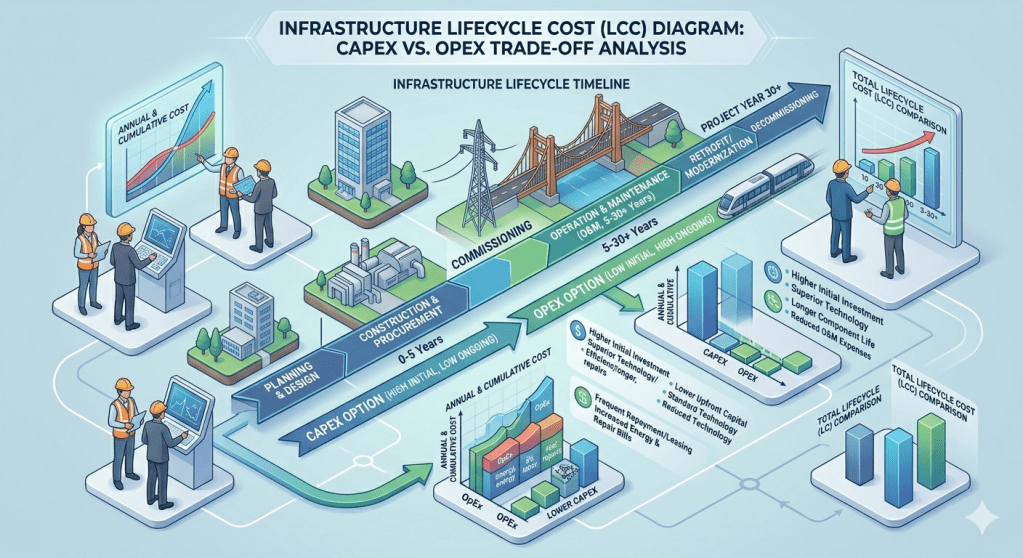
To properly evaluate projects, cost engineers use lifecycle cost analysis.
What Is Lifecycle Cost (LCC)?
Lifecycle cost represents the total cost of owning and operating an asset over its entire life.
Lifecycle Cost = CapEx + OpEx + Maintenance + Replacement Costs
Why It Matters
Lifecycle costing helps teams evaluate:
- total cost of ownership (TCO)
- long-term cost efficiency
- sustainability of design decisions
Instead of asking:
“What is the cheapest option to build?”
Teams ask:
“What is the most economical option over 20–30 years?”
Example: Infrastructure Project Trade-Off
Consider two design options for a highway project.
Option A — Lower CapEx
| Attribute | Value |
|---|---|
| Construction cost | $200M |
| Annual maintenance | $8M |
Option B — Higher CapEx
| Attribute | Value |
|---|---|
| Construction cost | $240M |
| Annual maintenance | $3M |
20-Year Cost Comparison
| Option | Total Cost |
|---|---|
| Option A | $200M + (20 × $8M) = $360M |
| Option B | $240M + (20 × $3M) = $300M |
Insight
Although Option B has a higher upfront cost, it is $60M cheaper over the project lifecycle.
This illustrates why focusing only on CapEx can lead to suboptimal decisions.
How Cost Engineers Evaluate CapEx vs OpEx
Professional cost evaluation uses structured financial methods.
Lifecycle Cost Analysis (LCCA)
Evaluates total cost over the project life, including:
- initial investment
- operating costs
- maintenance and replacement
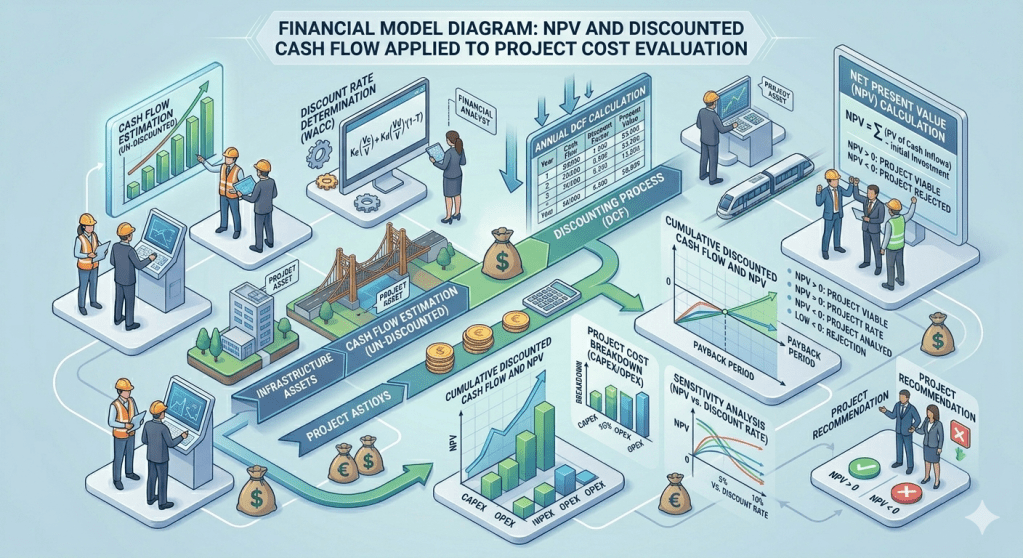
Net Present Value (NPV)
Net Present Value accounts for the time value of money.
Future costs are discounted to present value:
- $1 today is worth more than $1 in the future
- long-term OpEx must be discounted when comparing options
Discounted Cash Flow (DCF)
DCF analysis evaluates:
- timing of cash flows
- long-term financial performance
These methods ensure decisions are based on true economic value, not just nominal cost.
Framework: Evaluating CapEx vs OpEx Trade-Offs
Practical Decision Framework
| Step | Action |
|---|---|
| 1 | Define project alternatives |
| 2 | Estimate CapEx for each option |
| 3 | Estimate OpEx over lifecycle |
| 4 | Include maintenance and replacement costs |
| 5 | Apply discounting (NPV/DCF) |
| 6 | Compare total lifecycle cost |
This structured approach ensures data-driven decision making.
Common Mistakes
Even experienced teams sometimes misjudge CapEx vs OpEx trade-offs.
Focusing Only on Initial Cost
Selecting the lowest construction cost often leads to higher long-term expenses.
Ignoring Operating Costs
Underestimating OpEx can significantly distort project economics.
Underestimating Maintenance
Maintenance costs are often higher than expected, especially in:
- harsh environments
- complex facilities
Ignoring Lifecycle Performance
Design choices that reduce performance or efficiency can increase long-term cost.
Best Practices
Leading organizations apply the following principles.
| Best Practice | Benefit |
|---|---|
| Evaluate lifecycle cost | Captures total cost impact |
| Use financial modelling tools | Improves decision accuracy |
| Consider operational efficiency | Reduces long-term cost |
| Align decisions with strategy | Supports business objectives |
A strong CapEx vs OpEx strategy ensures optimal long-term project value.
Key Takeaways
- CapEx represents upfront investment; OpEx represents ongoing operating costs.
- Effective project decisions require balancing both.
- Lower CapEx does not always mean lower total cost.
- Lifecycle cost analysis provides a complete view of project economics.
- Investing more upfront can significantly reduce long-term operating costs.
 Cost Intelligence Lab
Leave a comment