
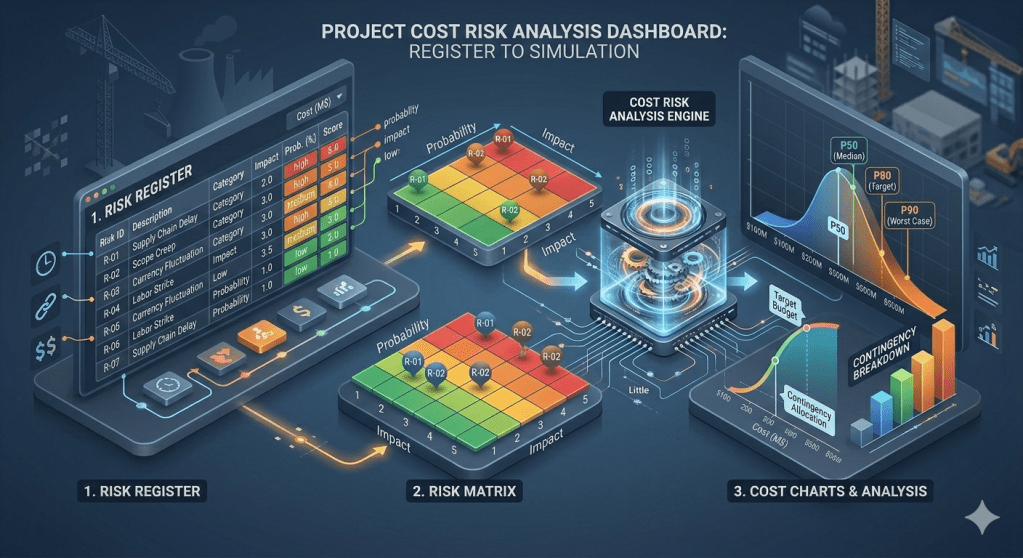
Introduction
All project cost estimates contain uncertainty—but uncertainty should be structured and analyzed, not guessed.
Too often, contingency is applied as a rough percentage without a clear understanding of what risks are actually driving cost uncertainty.
A well-developed Risk Register is the foundation for:
- realistic contingency calculation
- probabilistic modelling using Monte Carlo Simulation
- transparent and defensible project budgets
Without a structured risk register, cost estimates rely on assumptions rather than data-driven risk analysis.
What Is a Risk Register?
A risk register is a structured list of identified project risks, including key information required to assess and manage them.
In cost estimating, the focus is specifically on risks that impact project cost and budget outcomes.
Core Elements of a Risk Register
| Element | Description |
|---|---|
| Risk description | What could go wrong |
| Probability | Likelihood of occurrence |
| Impact | Cost consequence if the risk occurs |
| Risk exposure | Probability × impact |
| Mitigation strategy | Actions to reduce risk |
A properly developed risk register transforms uncertainty into quantifiable inputs for cost analysis.
Why Risk Registers Are Critical for Cost Estimates
Risk registers are not just documentation tools—they are essential for quantitative cost estimating.
Contingency Estimation
Risk registers allow estimators to calculate contingency based on:
- identified risks
- quantified impacts
- probability-weighted exposure
This replaces arbitrary contingency percentages with risk-based contingency.
Monte Carlo Simulation Inputs
Risk registers provide the input data required for probabilistic modelling:
- probability values
- cost impact ranges
- uncertainty distributions
These inputs feed directly into simulation models such as Monte Carlo Simulation.
Decision-Making Transparency
A structured risk register makes assumptions visible and traceable.
Stakeholders can see:
- what risks are included
- how they are quantified
- how contingency is derived
This significantly improves confidence in project estimates.
Types of Risks in Cost Estimating
Design Risks
These arise from incomplete or evolving project design.
Examples:
- incomplete scope definition
- design changes
- engineering errors
Design risks are most significant in early-stage estimates (Class 5–3).
Construction Risks
These relate to project execution.
Examples:
- labor productivity variability
- contractor performance issues
- construction sequencing challenges
These risks are critical during execution phases.
External Risks
External risks are outside direct project control.
Examples:
- material price escalation
- regulatory changes
- market conditions
These risks can significantly affect project cost outcomes.
Site and Geotechnical Risks
These are often major cost drivers, especially in infrastructure and mining projects.
Examples:
- unknown ground conditions
- groundwater issues
- environmental constraints
Key Components of a Cost Risk Register
A well-structured risk register includes standardized fields to ensure consistency.
Typical Risk Register Structure
| Field | Description |
|---|---|
| Risk ID | Unique identifier |
| Risk Description | Clear explanation of the risk |
| Probability (%) | Likelihood of occurrence |
| Impact ($) | Estimated cost consequence |
| Risk Exposure ($) | Probability × impact |
| Mitigation Strategy | Actions to reduce risk |
Example Calculation
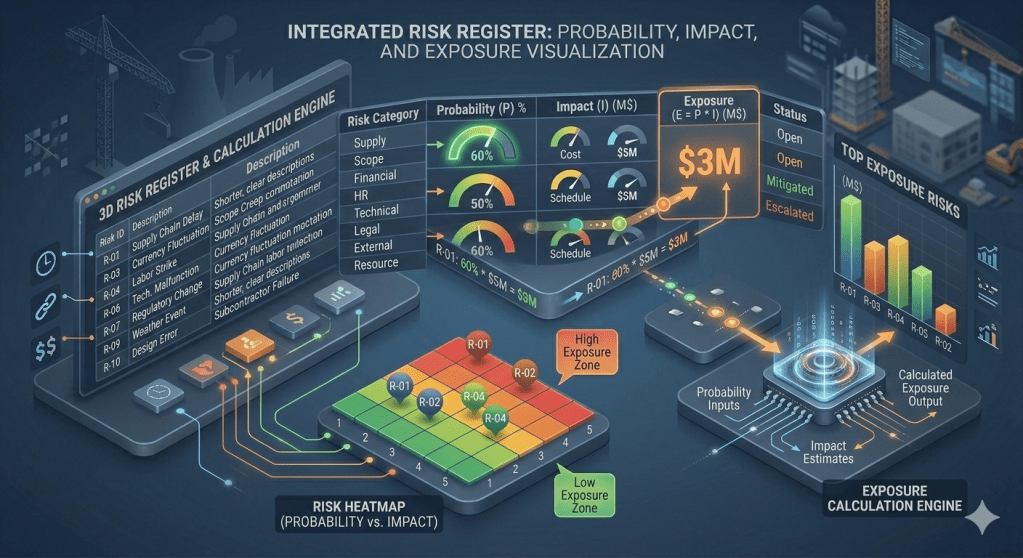
Risk Exposure = Probability × Impact
Example:
- Probability = 40%
- Impact = $10M
Risk Exposure = 0.40 × 10M = $4M
This metric helps prioritize risks based on financial impact.
Framework: How to Develop a Risk Register for Cost Estimates
Developing a high-quality risk register requires a structured process.
Risk Register Development Framework
| Step | Description |
|---|---|
| 1 | Identify risks |
| 2 | Categorize risks |
| 3 | Assess probability |
| 4 | Estimate cost impact |
| 5 | Calculate exposure |
| 6 | Define mitigation |
Step 1 — Identify Risks
Use multiple sources to identify risks:
- expert workshops
- historical project data
- lessons learned databases
Cross-functional input is critical.
Step 2 — Categorize Risks
Organize risks into categories such as:
- design
- construction
- external
- commercial
This improves clarity and analysis.
Step 3 — Assess Probability
Assign likelihood values based on:
- historical data
- expert judgment
- project-specific conditions
Step 4 — Estimate Cost Impact
Estimate the potential financial impact if the risk occurs.
Examples:
- minor delay → $500K
- major redesign → $5M
Step 5 — Calculate Risk Exposure
Quantify each risk:
Exposure = Probability × Impact
This enables risk prioritization.
Step 6 — Define Mitigation Measures
Develop strategies to reduce risk.
Examples:
- additional site investigations
- design reviews
- procurement strategies
- contractor selection improvements
Example: Risk Register for an Infrastructure Project
Consider a highway project at feasibility stage.
Sample Risk Register Entries
| Risk | Probability | Impact | Exposure |
|---|---|---|---|
| Unforeseen soil conditions | 40% | $10M | $4M |
| Material price increase | 25% | $8M | $2M |
| Weather delays | 20% | $5M | $1M |
These quantified risks provide a data-driven basis for contingency calculation.
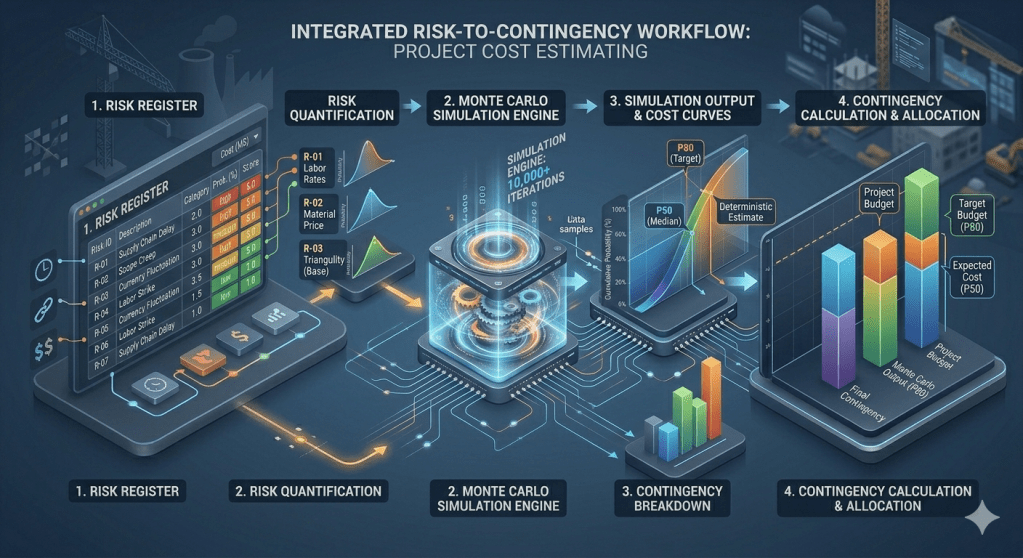
How Risk Registers Feed Contingency and Monte Carlo Simulation
Integration Workflow
Risk Register → Quantified Risks → Probability Distributions → Simulation → Contingency
Explanation
- Risks are identified and quantified
- Probability and impact values are assigned
- Inputs are converted into probability distributions
- Monte Carlo simulation generates cost outcomes
- Contingency is derived based on confidence levels (e.g., P80)
This process creates a fully traceable and defensible contingency calculation.
Common Mistakes in Risk Registers
Several issues can reduce the effectiveness of a risk register.
Missing Key Risks
Failure to identify critical risks leads to underestimated contingency.
Unrealistic Probability Assumptions
Overly optimistic or pessimistic assumptions distort results.
Inconsistent Impact Estimates
Lack of consistency reduces reliability of cost analysis.
Failure to Update the Register
Risk registers must evolve as the project develops.
Outdated registers lead to inaccurate estimates.
Best Practices for Risk Register Development
Experienced project teams follow proven practices.
| Best Practice | Benefit |
|---|---|
| Involve multidisciplinary teams | Captures diverse risks |
| Use historical data | Improves accuracy |
| Update regularly | Reflects project evolution |
| Align with CBS | Ensures cost traceability |
Aligning the risk register with the Cost Breakdown Structure (CBS) ensures risks are linked directly to specific cost elements.
Key Takeaways
- A risk register is the foundation of structured cost risk analysis.
- It enables quantitative contingency calculation.
- It provides essential inputs for Monte Carlo simulation.
- Well-developed risk registers improve estimate transparency and reliability.
- Integrating risk registers with cost structures significantly enhances project cost control and decision-making.
 Cost Intelligence Lab
Leave a comment